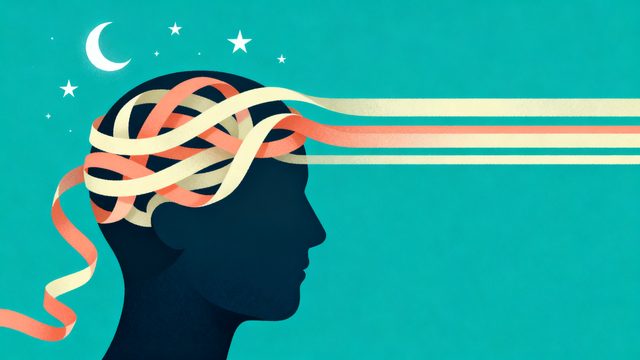
How to Quiet a Racing Mind at Night
You're exhausted all day, then the lights go off and your brain launches a TED talk about every mistake you've ever made. That's not insomnia — it's arousal, and it has specific off-ramps.
Why thoughts speed up at night
In bed, with no distraction, the day's unfinished loops finally get airtime. Add anxiety about not sleeping (performance pressure) and arousal rises — the opposite of what sleep needs. It's a feedback loop.
Techniques that actually lower arousal
- Cognitive shuffling: picture random, dull objects one by one — it interrupts the narrative loop.
- Get up: if awake 20+ minutes, leave bed; return only when sleepy. Protects the bed-sleep link.
- Worry window: schedule 10 minutes of worrying earlier in the evening, then close it.
- Breath pacing: slow exhales (longer out than in) nudges the calm nervous system.
Frequently asked questions
Why can't I sleep when I'm anxious?
Anxiety triggers the sympathetic nervous system (fight-or-flight), which raises heart rate, body temperature, and cortisol — all signals that keep your brain in "wake mode." The harder you try to force sleep, the more alert you stay.
Is sleep anxiety the same as insomnia?
No — insomnia is the inability to sleep despite opportunity; sleep anxiety is the fear of not sleeping that creates a self-fulfilling loop. Many people with sleep anxiety have perfectly healthy sleep architecture — they just can't access it.
What's the fastest way to calm anxiety at night?
Two techniques work best: (1) the 4-7-8 breath — inhale 4 sec, hold 7, exhale 8, repeat 4 cycles; (2) cognitive defusion — say "I notice I'm feeling anxious" rather than "I am anxious," which separates you from the feeling.
Should I get out of bed if I can't sleep?
Yes, after 20 minutes. Get up, do a calm activity in dim light (no screens), and return to bed only when sleepy. Staying in bed while awake trains your brain to associate the bed with frustration — get up to break the link.
When should I see a doctor about sleep anxiety?
If it happens 3+ nights per week for more than 3 months, or if it's affecting daytime function (concentration, mood, performance), it meets the threshold for CBT-I (Cognitive Behavioral Therapy for Insomnia), which is the gold-standard treatment.
References
- Baglioni, C., et al. (2016). Sleep and mental disorders: an update. Sleep Medicine Reviews, 26, 1–13.
- National Institute of Mental Health. (2024). Anxiety Disorders. nimh.nih.gov.
- NHS. (2023). Anxiety — Self-help guide. nhs.uk.