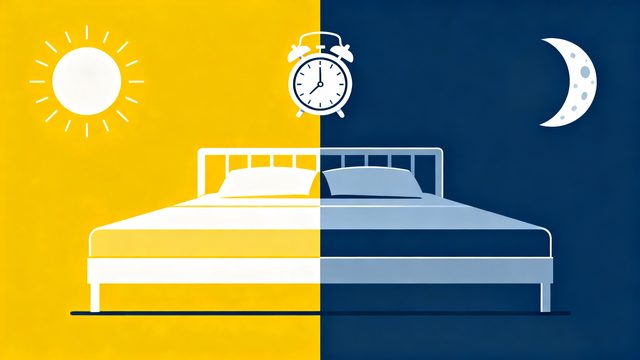
Social Jet Lag: Why Weekends Are Ruining Your Sleep
You go to bed at 11 on work nights and 2 a.m. on weekends, then sleep until noon. Congratulations — you're giving yourself a mild case of jet lag every single week, without leaving your city.
What "social jet lag" means
Coined by sleep researcher Till Roenneberg, social jet lag is the difference between your "social" sleep schedule (work/school) and your natural one (weekends). A two-hour gap is common; three or more is linked to worse metabolic and mood outcomes.
Why it's more than laziness
Your body clock doesn't reset on Saturday. When you sleep in, you delay your whole rhythm, then slam it back on Monday — the same misalignment travelers feel crossing time zones, repeated 52 times a year.
The Monday-morning zombie effect
That groggy, irritable start to the week isn't just psychology. It's a circadian mismatch: your cortisol awakening response and melatonin offset are fighting your alarm clock.
How to shrink the gap
- Keep wake time within 1 hour of your weekday time, even on days off.
- If you must sleep in, cap it — a 30–60 minute lie-in is far kinder than three hours.
- Use morning light (real sunlight or a bright lamp) right after waking to anchor the clock.
Frequently asked questions
What is social jet lag?
The mismatch between your biological sleep schedule (when your body clock wants you to sleep) and your social schedule (work, school, family obligations). It's measured in hours — most adults have 1-2 hours of social jet lag; shift workers and teens often have 3+.
Why is sleeping in on weekends bad for you?
It shifts your circadian clock later, so Monday-Wednesday you're essentially jet-lagged within your own time zone. Cognitive performance, mood, and even metabolism suffer. The "weekend lie-in" feels good but creates Monday-Wednesday drag.
How do I reduce social jet lag?
Keep your wake time within 1 hour of your weekday wake time, even on weekends. If you need extra sleep, take a 20-min nap before 3 p.m. instead of sleeping in. Morning bright light exposure also helps anchor your clock.
Is social jet lag the same as travel jet lag?
Same physiological mechanism (circadian misalignment), different cause. Travel jet lag is one-off and self-resolves; social jet lag is chronic and accumulates metabolic and cardiovascular costs over years.
How much social jet lag is normal?
Under 1 hour is normal. 1-2 hours is common and tolerable. Over 2 hours is associated with increased depression, obesity, and cardiovascular risk in epidemiological studies. Shift workers often have 3-4+ hours.
References
- Wittmann, M., et al. (2006). Social jet lag: misalignment of biological and social time. Chronobiology International, 23(1–2), 497–509.
- Centers for Disease Control and Prevention. (2022). Sleep and Chronic Disease. cdc.gov.