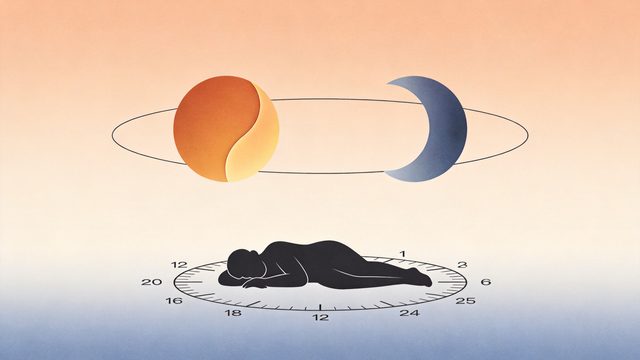
Circadian Rhythm: How Your Body Clock Works
You have a clock inside your head that's been ticking since long before alarm apps. It decides when you get sleepy, when you're sharp, and when you crash. Most "bad sleep" is really a clock that's been pushed out of sync. Here's how it runs — and how to stop fighting it.
What the circadian rhythm actually is
It's your body's roughly 24-hour cycle of sleepiness and alertness, driven by a rise and fall of hormones and core temperature. It's not the same as sleep cycles — those are the 90-minute waves inside a night; the circadian rhythm is the big daily tide those waves ride on.
The master clock and the light
Deep in your brain sits the suprachiasmatic nucleus (SCN), the master clock. Its single most important cue is light hitting your eyes. Morning light tells the SCN "daytime — switch off melatonin." Evening darkness tells it "night — release melatonin."
Melatonin: the darkness hormone
Melatonin doesn't knock you out like a sedative; it signals "night is here." Its curve rises in the evening, peaks mid-sleep, and falls before waking. Screens and bright bulbs in the last hour before bed flatten that curve and delay sleepiness.
6 ways to realign your clock
- Get light early: 10–20 minutes of outdoor light within an hour of waking anchors the day.
- Keep a fixed wake time: even on weekends, within an hour. This is the single strongest synchronizer.
- Dim the lights at night: warm, low light 1–2 hours before bed.
- Cut evening screens: or use night-shift / blue-light filters if you must.
- Time caffeine and exercise: both shift alertness; stop caffeine by early afternoon.
- Be consistent: a clock loves routine more than it loves duration.
Turn the clock into a plan
Once you know your body runs best on a steady wake time, the next question is when to be in bed. Work it backward from the time you must get up:
Frequently asked questions
How long is a circadian cycle?
Exactly 24.2 hours on average — slightly longer than a day, which is why your body clock drifts later each day unless reset by light. Morning sunlight is the strongest signal to push it earlier.
Can you reset your circadian rhythm quickly?
About 1–1.5 hours per day is the typical safe rate (e.g., shift workers and jet-lag recovery). Trying to shift faster causes the desynchronisation that makes jet lag feel so rough.
What disrupts circadian rhythm most?
Three big disruptors: blue light at night, irregular sleep schedules, and caffeine/alcohol within 6 hours of bedtime. Each shifts your clock 30 minutes to 2 hours later on its own.
Do circadian rhythms change with age?
Yes — teens have a delayed clock (they naturally want to sleep and wake later), while older adults shift earlier. The teen delay is biological, not laziness, and is why high schools that start later see measurable GPA gains.
How does jet lag affect circadian rhythm?
Jet lag is a misalignment between your body clock and the destination's light-dark cycle. Eastward travel (harder) requires advancing your clock; westward (easier) requires delaying. The Jet Lag Calculator plans this for you.
References
- Czeisler, C. A., et al. (1999). Stability, precision, and near-24-hour period of the human circadian pacemaker. Science, 284(5423), 2177–2181.
- National Institute of General Medical Sciences. (2024). Circadian Rhythms Fact Sheet. nigms.nih.gov.