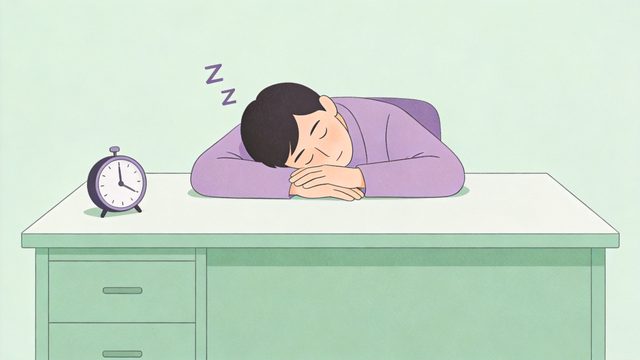
The 20-Minute Power Nap: A Workplace Guide
The post-lunch dip is real — your circadian rhythm dips in the early afternoon. A short nap can reboot alertness for hours, if you keep it short enough to avoid the groggy backlash.
Why 20 minutes, not 60
A 20-minute nap stays in light sleep, so you wake refreshed with no inertia. Push past ~30–40 minutes and you risk waking from deep sleep — the zombie effect — plus trouble sleeping that night.
Best timing
Aim for early-to-mid afternoon (roughly 1–3 p.m. for most). Too late and you steal from nighttime sleep; too early and you're not tired enough.
Napping at work
- Use a quiet spot, eye mask, and a phone alarm.
- Keep it under 20 minutes and frame it as a focus reset.
- Some workplaces now offer nap pods — use them shamelessly.
Frequently asked questions
How long should a power nap be?
20-25 minutes is the sweet spot. Long enough to feel restored, short enough to avoid entering deep sleep (which causes severe sleep inertia on waking). Longer than 30 min and you risk waking from deep sleep feeling worse than before. Some people do "90-minute naps" to complete a full cycle, but that's a different use case.
When is the best time to nap?
Between 1-3 p.m. — your circadian dip naturally causes a small energy slump then. Napping later interferes with nighttime sleep. Napping too early (before noon) usually doesn't happen because your homeostatic sleep pressure hasn't built up enough.
Are power naps actually beneficial?
Yes — 20-30 min naps improve alertness, reaction time, and mood for 1-3 hours afterward. NASA research on pilots showed a 26-min nap improved performance by 34% and alertness by 54%. Even 10-min "mini naps" help, though less than full 20-min naps.
Who shouldn't take power naps?
People with insomnia should avoid or strictly limit daytime naps — they reduce homeostatic sleep pressure and worsen nighttime sleep. Older adults with fragmented sleep should also nap cautiously. If you can't fall asleep within 5-10 min during a nap, get up and try later.
Is it OK to nap every day?
For most healthy adults, yes — short daily naps (20-30 min) before 3 p.m. are safe and beneficial. They don't typically interfere with nighttime sleep unless you're nap-dependent and skipping nighttime sleep. Cultural attitudes vary: daytime napping is normal in many countries and frowned upon in others, but the physiology is the same.
References
- Hilditch, C. J., et al. (2016). Sleep inertia: current insights. Nature and Science of Sleep, 8, 129–140.
- Waterhouse, J., et al. (2007). Jet lag: trends and coping strategies. The Lancet, 369(9567), 1117–1125.
- Centers for Disease Control and Prevention. (2022). Sleep and Chronic Disease. cdc.gov.