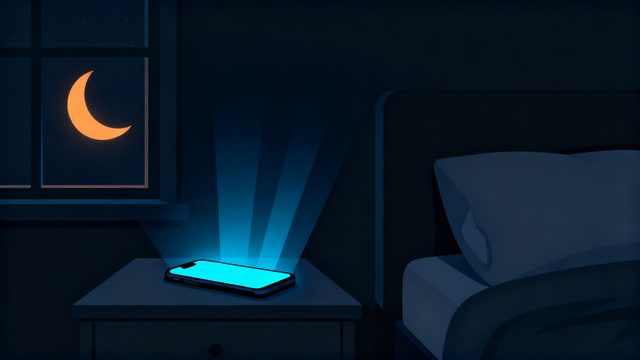
Blue Light and Sleep: What the Research Actually Says
Every "screen bad for sleep" article mentions blue light, but the story is more nuanced than "buy these glasses." Here's what the evidence supports — and what it doesn't.
Why light timing matters more than color
The real driver is light exposure timing and brightness. Bright light of any color in the evening delays melatonin; morning light advances it. Blue-enriched light is especially potent per unit brightness, but a dim screen is far less disruptive than a bright ceiling light.
What studies find
Evening blue-light exposure can delay sleep onset by shifting your circadian phase and suppressing melatonin. The effect size is real but modest for typical phone use at arm's length — larger for bright, close, prolonged exposure.
Practical takeaways
- Dim and warm your environment an hour before bed — not just the phone.
- Use night-shift / blue-light filters; they help a little.
- Get bright light in the morning — that does more for your clock than evening avoidance.
See how light drives your clock →
Frequently asked questions
Does blue light really affect sleep?
Yes, more than almost any other modern exposure. Blue light (around 480 nm) suppresses melatonin onset by 30-90 minutes compared to dim warm light, and shifts your circadian phase measurably in a single evening of use.
How long before bed should I avoid screens?
60-90 minutes is the commonly cited number, but the research actually shows meaningful melatonin suppression even within 30 minutes. If you can't ditch screens, switch to night mode + brightness down + distance (TV further than phone).
Are blue-light glasses actually effective?
Mixed evidence. The amber lenses block wavelengths that suppress melatonin, so physiologically they should help. Real-world studies show small but real improvements (5-15 min faster sleep onset). They're not magic, but they're not snake oil either.
Is reading on a Kindle better than a phone?
E-ink Kindles are essentially zero blue light, so yes — closer to reading paper. LCD tablets (iPad) still emit blue. For pre-bed reading, the older your Kindle the better.
What about Night Shift or Night Mode on iPhone/Android?
These shift the color temperature toward amber after sunset. They reduce blue light by 50-70%, which is meaningful but not complete. Combined with low brightness and held farther from your face, they get you to roughly the effect of a dim lamp.
References
- Harvard Medical School. (2012). Blue light has a dark side. Harvard Health Letter.
- Chang, A. M., et al. (2015). Evening use of light-emitting eReaders negatively affects sleep, circadian timing, and next-morning alertness. PNAS, 112(4), 1232–1237.