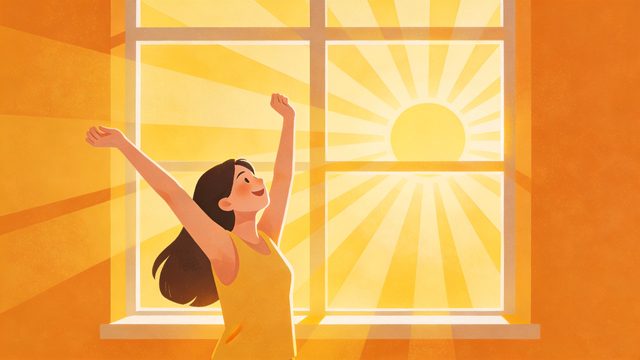
Why Morning Sunlight Is the Best Alarm Clock
Forget the app. The most reliable way to fix your sleep schedule is free and waiting outside: bright morning light. It's the signal your clock evolved to obey.
Light is the master synchronizer
Your circadian rhythm is anchored primarily by light exposure timing. Morning light advances your clock (earlier, better sleep); evening light delays it. A walk at sunrise does more for consistency than most gadgets.
How much, how soon
- Aim for 10–20 minutes of outdoor light soon after waking (longer on gray days).
- Indoor light through a window is much weaker — get outside or use a 10,000-lux lamp.
- Pair it with your first water/coffee for a reliable habit.
Frequently asked questions
How long should I get morning sunlight?
10-30 minutes within the first hour of waking. The intensity of outdoor light (even on overcast days) is 50-100x brighter than indoor lighting, which is what resets your circadian clock. Skipping this is one of the most common reasons for delayed-sleep-phase patterns.
Does morning light really help you sleep at night?
Yes — it's the strongest single non-pharmacological lever for circadian timing. Bright morning exposure advances your sleep phase (you get tired earlier), and missing it for several days delays it (you get tired later). The effect is measurable in 2-3 days.
Do I need sunlight directly, or is light through a window enough?
Through a window is about 80% of the way to direct outdoor exposure. Better than nothing, but if you can go outside — even on a balcony — that 20% gap matters, especially in winter when outdoor light is already dim.
What if I wake up before sunrise in winter?
Use a 10,000 lux light therapy box for 20-30 minutes right after waking. Light therapy lamps are clinically validated for seasonal affective disorder and shift-work adjustment. Aim the light at your eyes but don't stare directly at it.
Can I get morning light too late and still benefit?
The "morning window" for circadian benefit is roughly within 2 hours of your typical wake time. After that, the effect on phase shifts drops off quickly. If you can't manage the first 2 hours, midday outdoor light is the next-best option — better than afternoon but not as potent as morning.
References
- Czeisler, C. A., et al. (1980). Stability, precision, and near-24-hour period of the human circadian pacemaker. Science, 209(4458), 720–723.
- Terman, M., & Terman, J. S. (2005). Light therapy for seasonal and nonseasonal depression: efficacy, protocol, safety, and side effects. CNS Spectrums, 10(8), 647–663.
- National Institute of General Medical Sciences. (2024). Circadian Rhythms Fact Sheet. nigms.nih.gov.